
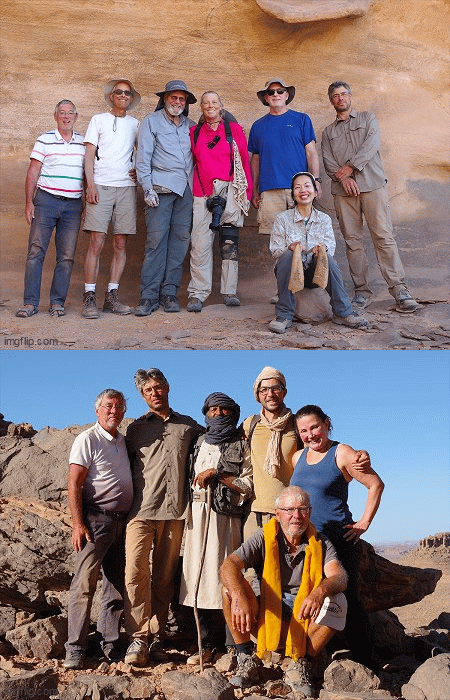
 Click on image for list of participants |
Tassili N'Ajjer, Algeria 10th October - 6th November, 2025 There is no published catalogue and accepted nomenclature of the Tassili sites, the provided site numbers are for convenience only, developed by myself utilising the topographical names used by the Lhote missions and others to be able to reference individual shelters. False colour images processed with DStretch, a software developed by Jon Harman |
The northern part of the Tassili du Tamrit (the part of the Tassili adjacent to Djanet containing the classic sites recorded by the Lhote missions) is far less known and visited than the southern part. In October 2023 we already made a visit, but much was left unseen. This time we returned for a 17 day camel supported trek, again with Abu Bakr as our guide, passing by several previously unvisited remoter localities, and re-locating a number of Lhote's recorded sites which were "lost" in the elapsed years. After returning to Djanet we made another 10 day trek with Dagarat in the central Tassili, with the primary objective of seeing wildlife.
Day 0. – Algiers - Djanet
We took the usual late evening flight to Djanet (now that it was elevated to the rank of Wilaya (provincial capital), there are flights from Algiers every day). Those coming from overseas already spent a day or two there, we met in the afternoon / evening at the domestic terminal. Arriving in the small hours, we spent the remainder of the night at the Essendilene Voyages premises.
Day 1. – Djanet - camp at foot of plateau
In the morning I made the usual shopping round for supplies at the local market, while the rest of our party made a quick visit to the engravings and paintings reported by Reygasse and Lhote near Azelouaz. After sorting and packing our supplies and gear we drove about 20 kilometres to the North to the campsite where the camels were already awaiting us for an early start the next morning.
Day 2. – Camp - Tajouiset
In the old days there was a passable car track leading to the foot of the Akba Assakao (built by the French army in the nineteen fifties), Abu Bakr recalled driving his Landrover up to the pass in the seventies, but as time progressed the track fell into disrepair, and the recent rains washed away large sections, now it is impossible to reach the pass with car. There is a torturous track leading up from near Aït Talwaten which we took in 2023, but time wise it saves very little, it takes nearly a day to get 9 kilometres closer to start, the same is easily achievable on foot. After packing our gear we started out, first along the car track (which became completely impassable for cars after about 2 kilometres), then turned into a side valley towards the high plateau.
Taking this route had an added bonus. In 2011 Suzanne and Gérard Lachaud reported a very interesting shelter with paintings of elephants at Tajouiset Cahiers de l'AARS No. 15 about a day's march from our campsite. After a midday rest in the side valley we continued, rising slowly but continuously. By late afternoon we reached a short low pass, beyond which lay the sandy valley of Tajouiset, a good 300m higher in elevation than where we started from in the morning.
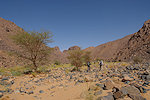
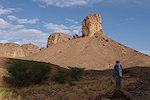
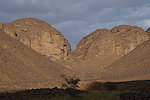
The site itself was not easy to find, it was not at the reported location, we all spread out to look for it. It was close to dusk when Abu Bakr finally found the shelter several hundred metres from where we thought it to be, we left photography for the following morning.
Day 3. – Tajouiset - Akba Assakao
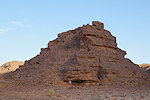
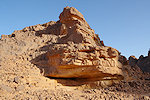
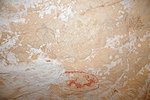
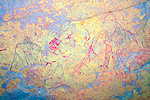
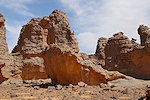
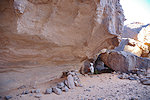
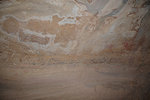
The site was in the direction of our intended passage, we packed camp and walked up to it while our crew were still out looking for the camels. On approaching one first notices some bright camel period paintings on the rear wall of the shelter, the rather faint scene with elephants and therianthropes is on the ceiling.
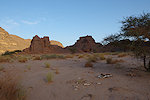

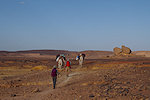
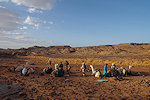
The remainder of the morning was spent walking along the easy trail towards the foot of the pass, passing a guelta where we could top up our water containers. My midday we reached the small plain just at the foot of the main pass, leaving the ascent for the afternoon after lunch and a midday break.
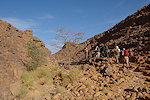
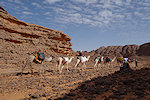
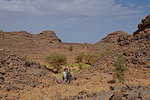
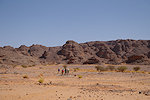
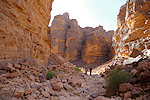
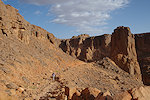
Mid-afternoon we entered the canyon leading to the steep part of the pass, which already had shade along its bottom. This ascent is by far the easiest among all the Tasili passes (already half of the ascent was done gradually the previous day and in the morning), in an hour and a half we made it to the top. We continued for another couple of kilometres on the plateau to make camp in a shallow wadi where there was plenty of foraging for the camels.
Day 4. – Akba Assakao - Ti Djedjan
Our morning target was the area of Ti Djedjan, a cluster of sites reported by Suzanne and Gérard Lachaud (as Ti Jejan) in Cahiers de l'AARS No. 15. Abu Bakr knew the area well (but not the sites), along the way he talked about spending many weeks here as a small child with his grandparents. We were mostly following the piste that was built to the top of the pass by the French Army for the 1960 Lhote mission. As we approached the area Cornelius spotted a couple of gazelle in the wide valley beyond, and dashed away towards them to attempt some photos, while the rest of us continued to the first (and not very exciting) sites on the ridge overlooking the valley.
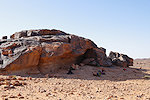
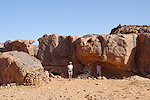
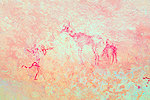
The bulk of the reported sites as far as we could see were in a narrow and deepening wadi further west that led towards the edge of the plateau towards the north. As we approached, we fund a very nice example of an "antenna monument", a peculiar type of funerary monument with a central tumulus and two protruding straight low walls at an angle. These monuments may be found all over the western and central Sahara, some huge while this one was of an unusually modest size.
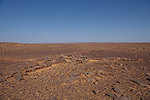
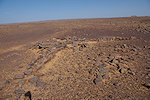
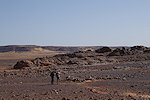
The first sites we encountered along the edge of the wadi were also not very exciting, some camel period and very faint pastoralist paintings, not the splendid roundhead scenes we were looking for based on the Lachauds' publication. While we were checking the shelters Cornelius caught up with us, he did manage to get a few distant but good shots of what turned out to be a herd of five Dorcas gazelle.
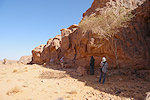
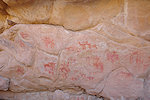
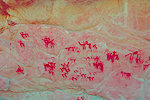
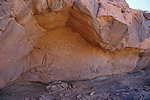
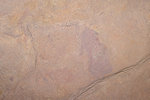
While we were scrutinizing the walls of the second site we found, Mike (a professional cave diver with an affinity to cramped places) explored a low uncomfortable shelter where I would never have looked for paintings, and found a very nice panel of somewhat unusual human figures, hidden on the slanting ceiling.
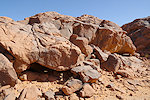
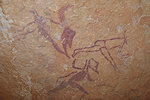
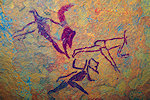
While we were busy in the low shelter, Kent & Fenny wandered about, and soon came back reporting that they found the shelter with some roundhead paintings just a few dozen metres away. This finally turned out to be one of the scenes we were looking for. As we finished and started to move on, a fourth shelter in the same general area was found, also with scenes published by the Lachauds.
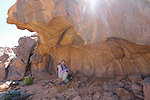
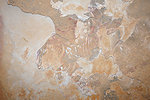
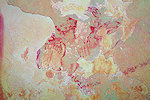
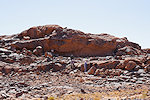
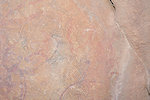
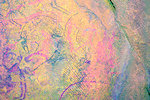
We still did not find the most interesting scenes published by the Lachauds, and there was one remaining waypoint about a kilometre further downstream in the valley. The site turned out t be more of a vertical wall than a shelter, and here finally we found the barbary sheep and elephants familiar from the published photos.
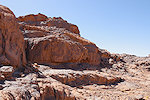
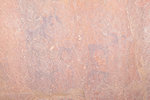
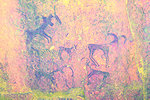
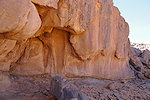
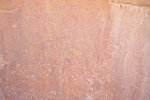
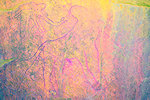
It was still late morning, we went to the edge of the wide plain towards the east where our camels stopped for midday. We had the whole day allotted to Ti Djedjan, but it made sense to cover some distance towards our next destination in the afternoon, so we set out towards the road, then along it, covering a good six kilometres of the way we intended to do the next day before making camp in the sandy bottom of a wadi.
Day 5. – Ti Djedjan - Abarkakou
In the morning we continued along the road which led generally towards the north along a broad valley. After about four kilometres we reached the point where we needed to turn east into a wadi heading towards Abarkakou, our target. There was a sandy pass leading down into the valley, our camels just caught up with us so we allowed them to pass first, making sure that they all reach the bottom without any mishaps.
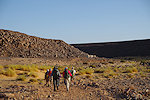
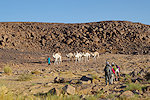
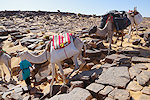
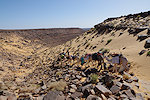
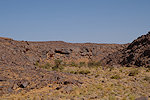
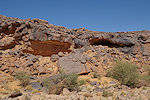
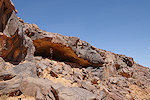
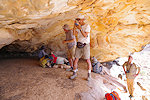
We reached the entrance of the deep canyon with the Abarkakou guelta in another three kilometres. The 1960 Lhote mission prepared a copy of an extremely fine Iheren style scene somewhere around this locality, however for a very long time the precise whereabouts of this shelter was unknown, until finally in 2024 Frederique Duquesnoy finally managed to engage a guide who knew the guelta by this name, and Frederique found the site nearby. It is a large shelter high up along the side of the valley, almost a kilometre before reaching the guelta. The scenes are on the ceiling in several sections, and count among the most spectacular Iheren style panels. It was definitely one of the trip highlights, we spent several hours photographing all the fine details.
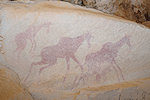
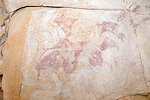
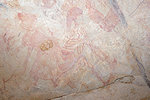
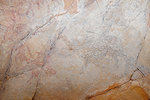
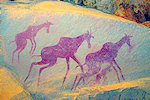
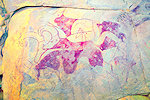
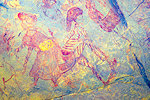
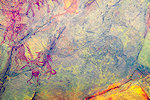
There is a shallower shelter to the left of the main one, on a somewhat lower lever, this too had some scenes on the high rear wall, though mostly discernible only with DStretch.
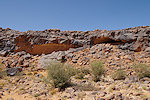
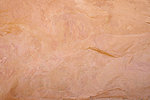
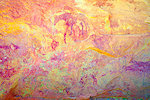
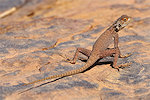
Our camp was just beside the guelta where we could find a few good sandy patches (but not much shade). It was guarded by a large and quite friendly resident agama (Agama tasiliensis) that kept coming back for crumbs as we had our lunch.
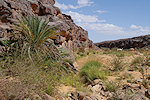
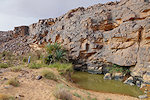
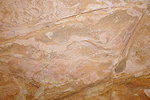
There was a large shallow shelter near the guelta, I was not aware of any more paintings in the area but it appeared worth checking out before the afternoon sun reached it. At first it appeared to be empty, but on close look it was full of faint but very fine Iheren style scenes, including a Rhinoceros hunt. Some figures including a unique fallen giraffe were outlined in pencil, so clearly the 1960 Lhote team visited and copied it, but there is no corresponding relevé in the MNHN (Frederique also saw this site as it later emerged).
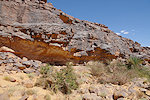
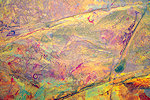
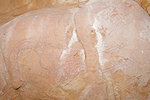
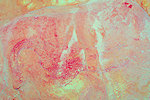
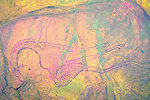
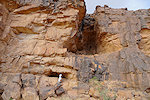
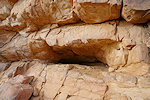
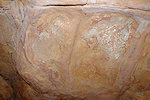
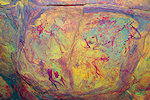
We still had practically the whole afternoon, some elected to go back to the main shelter for more photos, others explored the valley further downstream. We did not find much else, not far beyond the guelta there were a series of shelters in the vertical wall of the canyon, but only one small niche contained some Iheren style figures.
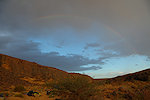
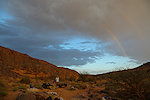
While we were exploring dark clouds moved in, and we did get a few large drops of rain that made everyone scramble to cover the bags and supplies the best we could. Fortunately the bulk of the shower missed us, and soon just a big double rainbow indicated that there was rain high up that never reached the ground.
Day 6. – Abarkakou - Assadjem Ouan Mellen - Téchekelaouen - Ouan Selalamine
We had a long day ahead of us with a number of fine sites to be visited. In the morning we ascended the plateau to the south of our camp and headed almost directly south towards the site of Assadjem Oua Mellen (Tin Tartaït) which we already visited in October 2023. It was easy going, we covered the roughly six kilometres in little over two hours.
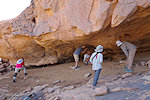
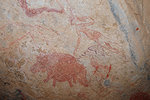
The Assadjem Ouan Mellen shelter (referred to as Tin Tartaït by present-day guides) was first noted by Jolantha Tchudi in 1951 (and subsequently visited and copied by the 1960 Lhote mission), it is one of the exceptional sites on the Tassili, with a number of unique depictions including the famed pair of therianthropes. It contains scenes and superpositions from a number of periods, naturally a lengthy photo session ensued.
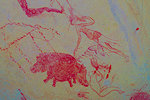
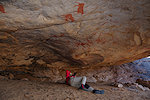
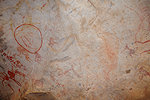
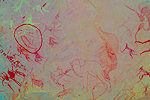
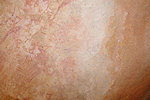
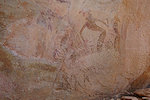
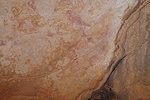
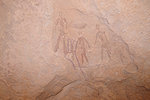
It was another two and a half kilometres to the sites of Téchekelaouen, which we covered in about an hour, arriving before midday. Abu Bakr left us at this point to find the rest of our crew and the camels who were making a much longer circuitous route suitable for camels, and lead them to or intended campsite at Ouan Selalamine. As we have spent two days at Téchekelaouen in October 2023 I had most of the sites and scenes photographed, I focused on scenes that I missed or failed to capture properly, like the chariot at site TC 7 or the figure with the "Pompadour hat" at TC 2.
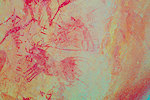
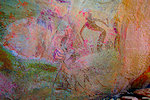
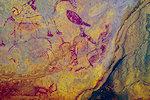
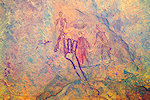
After lunch and a little rest we continued on the remaining one and a half kilometres towards the east, to our camp along the edge of Ouan Selalamine. On the way we passed a small keyhole monument, and rounding a small hillock we soon noticed the white specks of our camels on the grassy plain below - our crew made it safely to camp.
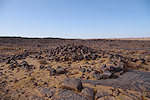
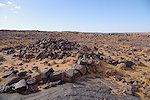
Ouan Selalamine is really the western suburb of Tissoukaï along the western bank of the Oued Idoo. In 2023 we only had a brief afternoon to visit the sites noted by Bernard Fouilleux, a number of Lhote relevés remained unaccounted for. This time we planned for a full day at the site, moving to Tissoikaï the following afternoon. As we arrived early, we still had some time to visit the principal known sites.
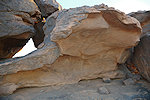
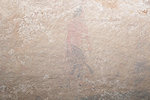
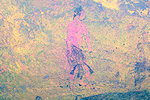
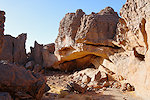
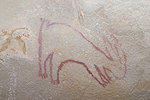
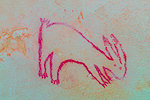
It was still an hour till sunset, after visiting the main site (OS 1) in the southern part of the area we spread out to search for the other sites. On satellite imagery I identified some likely spots (with a semi-circle of stones in front), at one of these I managed to locate the big roundhead figure on one of the missing relevés.
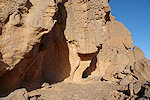
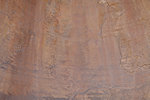
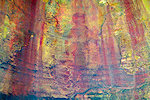
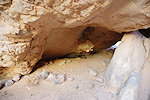
Abu Bakr also found a small site near camp, a shelter that still contained some nomad's belongings. Hidden behind these there was a small panel of human figures which was apparently missed by the Lhote team, or not considered worthy of copying.
Day 7. – Ouan Selalamine - Tissoukaï
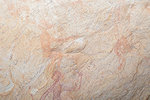
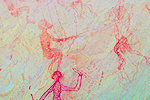
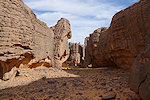
In the morning we continued with our search of the likely sites among the rock outcrops. Right at the first location we found a cluster of three shelters in a closed-off "street" all of which contained traces of paintings, one of them a large panel of hard to make out roundhead figures with numerous superpositions.
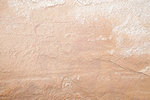
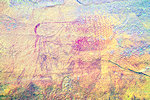
The other identified spots turned out to be empty, so we moved on to the northern area, to the supposed spot of the "hyena" tracing of Lhote, which we failed to find the last time. As the recorded positions of Bernard Fouilleux are usually very good, I returned to the spot where in 2023 we could not see anything. This time, perhaps with a different lighting, I noticed that there is a small dark opening behind a nearby recent stone wall. Climbing in, I found myself in a small dark cave, with the sought panel of paintings on the right wall (the animal appears to be more like a calf).
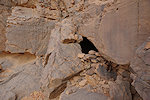
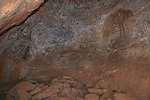
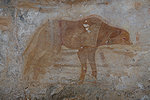
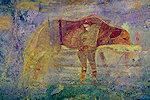
Above this site, on the plateau top I had another couple of likely spots identified. We made a round of them and did find three minor sites, none of which appear to have been recorded by the Lhote mission.
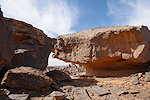

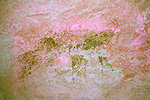
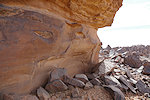
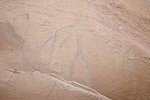
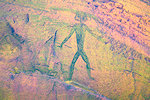
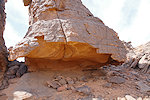
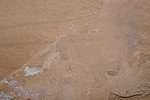
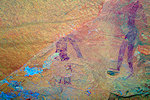
Descending to the central part of the area we continued our search, and found another three small sites, interestingly again none that were recorded previously.
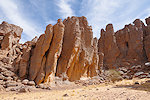
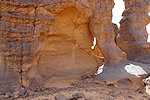
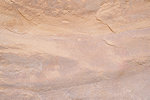
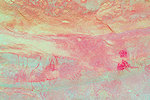
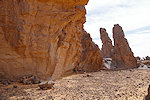
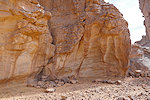
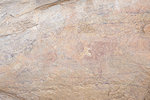
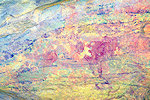
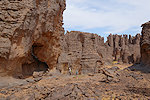
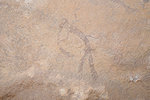
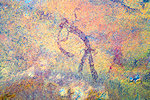
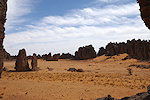
By this time it was becoming rather hot, we made a beeline towards camp. Near the site with masks copied by Lhote we found another two minor unrecorded sites, one with an unusual scene of cattle with riders.
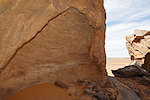
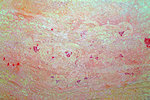
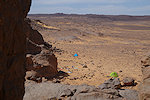
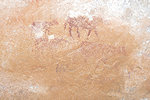
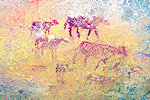
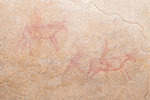
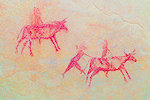
As we descended to camp for lunch and some rest, Abu Bakr awaited us with the news that he found another site right at camp. Sure enough, there were a couple of faint human figures on the wall right behind where our crew were resting.
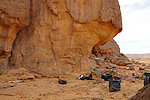
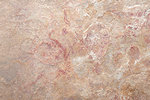
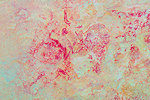
After lunch we packed camp, then set out to continue exploring the eastern edge of Ouan Selalamine, facing the Oued Idoo, with our camels to follow to the Tissoukaï camp. We did find two more small sites facing the oued, neither of which have been recorded by the Lhote mission. It is quite puzzling that despite having searched the area quite systematically, three relevés remain to be located.
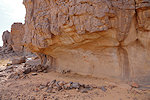
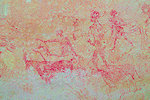
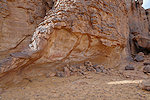
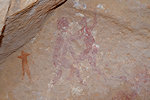
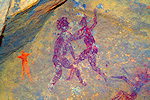
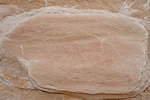
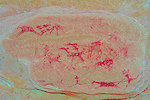
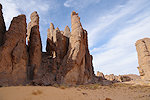
We crossed the Oued Idoo to the western edge of Tissoukaï, and spent the remainder of the afternoon going through the cluster of sites there, somewhat removed from the main concentration around our camp. I did manage to find one of the still missing Lhote relevés at site TS 10, but several marked to this area still remain.
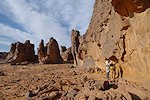

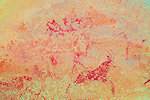
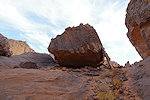
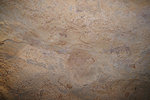
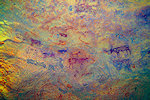
Day 8. – Tissoukaï
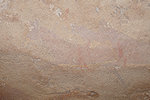
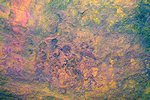
We planned for two full days at Tissoukaï, both to see the known sites, and to try to locate the still missing ones. In the morning we did a quick round of the principal sites around camp for orientation, allowing everyone to re-visit and take photographs at their own pace, while I set off with my to-do list of still missing sites and scenes to locate as many as I could. I started out near the well known wild ass hunt scene (TS 78), opposite which on a rock wall there supposedly was a bizarre painting of a snake (?) according to the Lhote map. Last time despite repeated passes I was unable to find it, this time I thought I saw some traces of red paint. Using DStretch on my phone, the indistinct figure of the snake finally emerged, which also made it clear that the Lhote copy as presented on the MNHN website was upside down, the head is in fact towards the left.
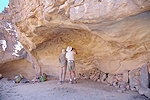
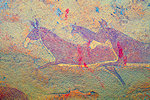
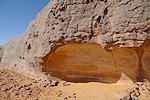
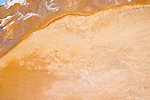
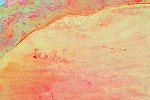
Two years ago for some reason I have completely missed site TS 82 along the southern side of the area, a double shelter which on first look only contains some late pastoral (caballine) figures, but there are two very faint Iheren style scenes, both of which were copied by Lhote.
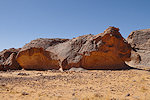

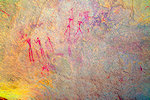
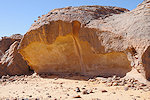
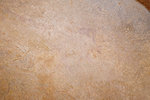
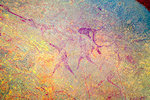
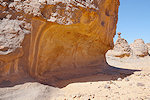
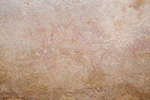
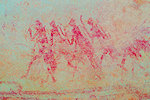
I spent a substantial amount of time checking the walls along both sides of the "street" leading to camp where supposedly there was a scene of three large figures very reminiscent of the three walking figures at Tin Abenhar. I did find the scene of two figures with "Pompadour hats" that I missed before, and after repeated passes through both sides I finally found the three extremely faint figures just around the corner from camp.
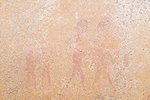
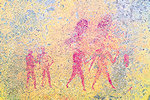
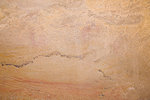
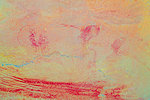
We agreed to meet back in camp at 1pm for lunch, with some electing to stay for a rest afterwards, others dispersing again. In the "Place Lhote" west of camp I did manage to find another of the missing panels, right where it was supposed to be on the east wall, but so faint that I missed it completely the last time. On the adjacent wall there was supposedly another panel somewhere high on the wall, but despite my best efforts I could not find it, though I did find some missed details on the adjacent known panel.
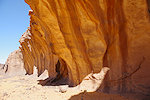

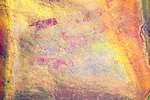
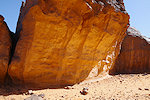

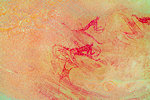
The western wall of the "Place Lhote" is one almost continuous panel of paintings (sites TS 44 and 45). This time with the benefit of knowing the scenes I could spend a long time with the telephoto lens capturing close-ups of many fine details.
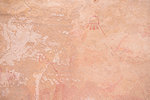

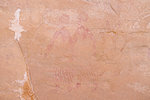
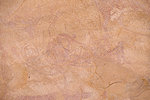
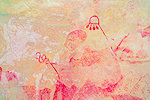

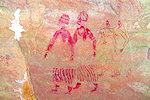
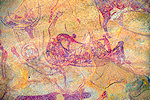
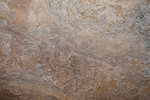
Mid-afternoon we set out together to see the sites at the eastern extremity of Tissoukaï, some of which we did not visit in 2023. At the "caballine" site along the southern edge I spent a long time trying to find a scene of several very fine Iheren style sheep copied by Lhote, clearly attributed to this site (TS 106). After a lengthy search finally the pencil tracings gave them away, the original paint was practically invisible.
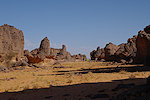

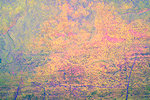
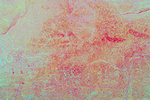
We walked to the very end of the area, where the terrain drops towards a big basin towards the east. Overlooking the edge of the basin there is a cluster of rocks with paintings on both sides of the largest one. The better preserved panels (site TS 120) were copied by the Lhote team.
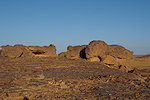
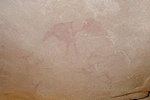
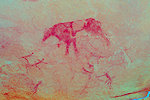
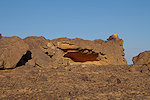
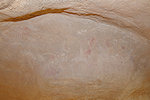
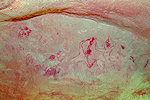
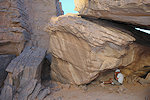
We still had a bit of daylight left, we made a quick search of the area to the rear of the known eastern sites to find a cluster of three sites which were marked on the Lhote map with an "X". Again Mike excelled, within a few minutes he found two of the missing sites, both extremely faint and one hidden in a deep shelter under a small rock.
Day 9. – Tissoukaï
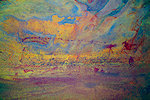
In the morning we set out together to visit the most spectacular site of Tissoukaï, the cave of Brenans (TS 12) with the amazing Sefar-Ozanehare style panel, as well as many roundhead scenes. Last time my camera batteries depleted before I could complete all photos and we had no spare time to return, this was a welcome opportunity to re-take the photos.
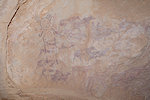
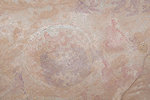
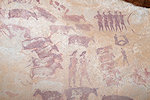
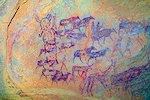
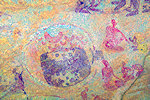
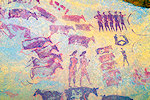
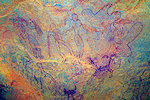
At the adjacent TS 14 site there are two adjacent roundhead style warthogs, last time I only managed to capture one of them.
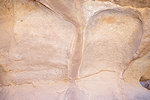

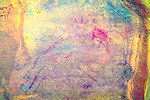
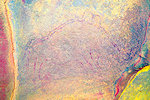
We moved towards the western edge of the rocks, to site TS 5 where earlier in a very bad light I have missed details of a number of important scenes, including a good overview of the roundhead style figures with "antennae".
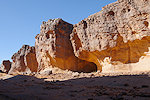
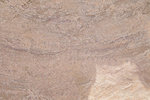
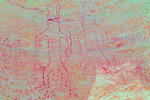
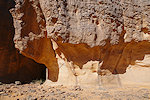
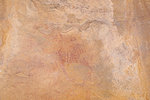
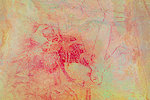
There were three more Lhote relevés somewhere in the general area of TS 5 ("Sortie Tilmas") which however were not marked on the map. We spent a good hour searching every possible rock face in the vicinity, but failed to find any. We returned to the central area south of camp, where we still had a number of sites to visit. I took the opportunity to look for one that I could not locate the last time despite going round and round the place it was marked. Later I realized that there was one place I did not look, on the top of the rock. Satellite imagery did show a likely shelter in a depression on top, climbing up in a passage I immediately found the site with a "boat" (eared serpent).
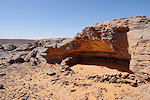
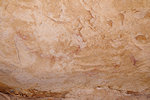
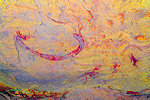
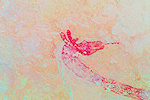
To finish off the morning I moved to site TS 93, within sight of camp to the north, to find the panel of strange animals (Lhote called them pigs) which were clearly marked to be at that site. Taking a very careful look at the wall I finally found the very weathered traces (and I realised why I missed them before), even DStretch does not help much.
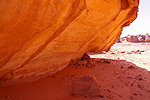
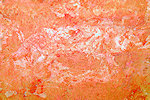
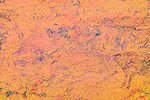
After lunch we headed to the northern area where I left off at noon, to see the cluster of fine sites. At TS 90 only a couple of camel period paintings are visible, but there is a large figure which we noted before. However, there is also a very interesting small panel of yellow figures underlying some white cattle, practically invisible, though a Lhote copy does exist. This time with some searching we did manage to find this scene. Another panel I lacked good photos of was the strange beast (aurochs ?) at site TS 99, this time I could remedy this deficiency.
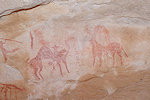
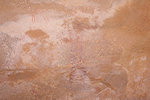
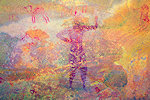

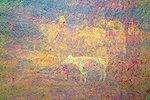
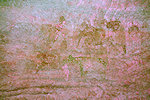
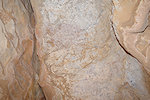
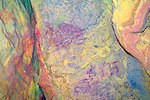
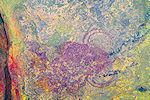
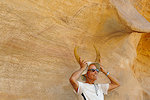
We finished our round of known sites at the magnificent Giant Buffaloes (TS 113), where we took our group photo, a pair of aoudad horns providing the opportunity for some additional amusement.
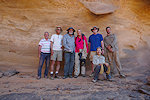
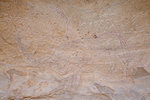
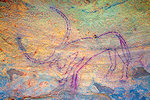
On the incomplete Lhote sketch map two sites were marked with "X" about 150 metres to the east of TS 113. They were easy to find right where marked, the first not very exciting but the second had a nice Sefar-Ozanehare style panel including a figure with "Pompidour hat". Strangely despite the marking on the map neither site has a corresponding relevé.
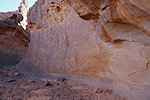

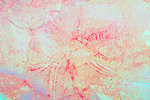
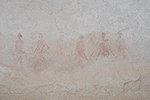
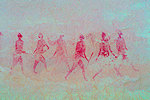
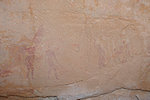
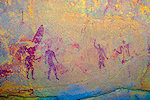
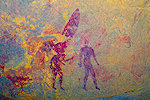
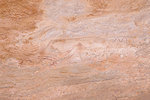
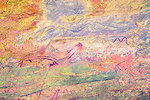
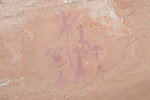
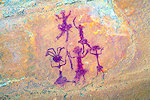
On the far side of a large rock outcrop Barbara and Mike found another site which was not marked on the map, with an intriguing roundhead style animal and some figures of a style which we have not seen before at Tissoukaï. Here too there was a large semicircle of stones placed in front of the shallow shelter.
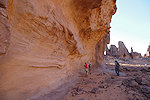
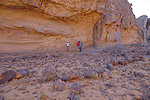
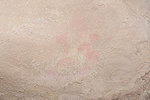
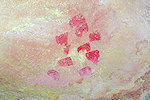
To finish off the day we went back to the two sites we found the previous evening near the eastern end, to search for the remaining one. We did find one faint panel of a flock of sheep with only the red bodies remaining, but it did not match any of the still missing Lhote relevés.
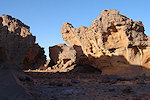
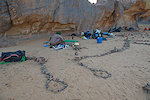
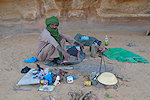
We returned to camp by sunset, our crew obviously had too much time on their hands as they have done a veritable landscaping, with built paths decorated with little towers leading to the campsite.
Day 10. – Tissoukaï - Rhardes
One of our key objectives on this trip was to continue exploring Rhardes, the area to the north of Tissoukaï on the far side of the Oued Idoo. Last time we could only afford a long afternoon, now we had a full day, plus the benefit of having already found in 2023 nearly half of the sites recorded by the 1960 Lhote mission. We started straight after breakfast, this time going directly to the central area with the main cluster of sites, leaving any exploration for the return.
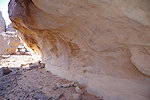
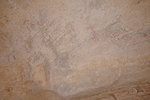
Our prime target was to find the unique depiction of a Giant buffalo (Syncerus antiquus) recorded by the 1960 Lhote mission, but the copy had no notes to provide any clue as to the location, it could have been anywhere within the 2 square kilometre area. With a spell of extreme luck soon after we arrived I spotted on a rock wall near other known paintings two faint red smudges, which after checking with DStretch turned out to be the human figures above the buffalo, which itself was practically invisible until one knew exactly where to look.
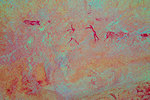
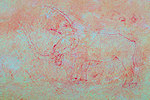
There were two more missing Lhote relevés near the principal sites, based on the descriptions relative to other panels we found them easily, though they were not very spectacular.
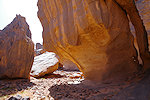
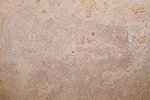
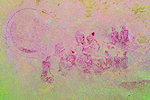
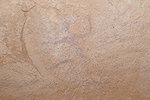
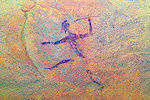
With the main objective of the day (if not the whole trip) already attained by 9:30am, we had a more relaxed time ahead of us. I have identified a couple of shelters with stone enclosures on Google Earth near the northern end of the Rhardes area, a good 1-1.5 kilometres beyond the last known sites. I was not sure we would have time for these, but now we could easily afford a visit, it was still mid-morning. We moved to the last known sites we visited in 2023, and left our packs there to lighten the load and go just with cameras. The first site turned out to be empty, so did the second, but near it we did find a rock wall with some faint paintings of goats and humans.
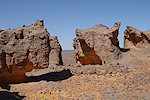
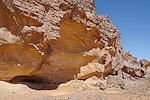

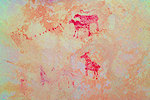
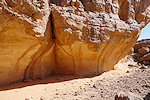
Continuing to near the northern end of Rhardes, we found a very impressive large shelter in a walled-off "street", which however turned out to be disappointingly empty. On a low wall on a rock just beyond the shelter I did find some practically invisible traces of paint, I took some point blank shots. Back home it turned out that this panel was one of the missing Lhote relevés, a fine Iheren style herd of cattle.
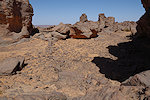
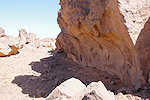

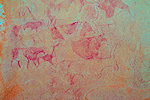
There was just one remaining identified enclosure a hundred metres further, here too there was a high wall forming a shallow shelter, this time we did find some very faint traces of white and red paint, but the individual figures are almost impossible to make out.
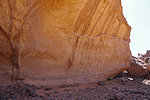
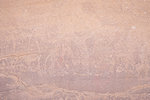

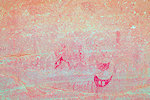
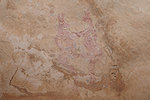
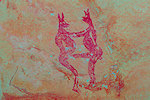
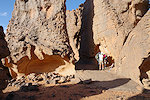
We returned to the group of sites that Lhote termed "station en croix" on account of them clustered around the crossing point of two perpendicular "streets". There were still a number of Lhote relevés missing, we did a thorough search of the area but found nothing other than the panels already found in 2023. Once we were done taking photos we had a quick lunch, and even had time for a little afternoon nap in the hottest hours. As we were taking our rest in the shade, Fenny lying on her back spotted some faint traces of paint on the ceiling above. They turned out to be the pair of therianthropes we were searching for, a close scrutiny revealed another two of the Lhote tracings in the same shelter and some further figures, right opposite one of the known sites.
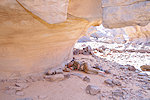
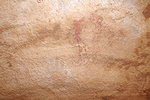
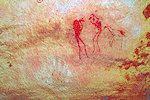
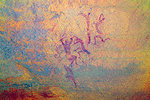
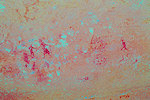
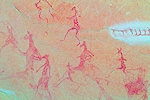
On our way back to our camp at Tissoukaï we passed three small unreported sites at the southern extremity of the area which we noted already in the morning, but then they were exposed to the sun and unphotographable. One of them contained a remarkable scene of running therianthropes, strangely not copied by the Lhote mission despite being right next to two sites that were.
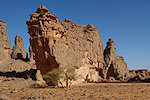
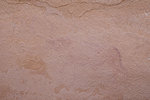
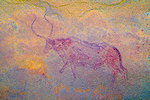
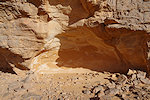
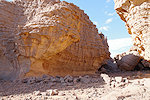
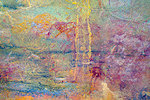
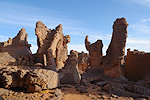
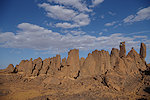
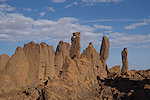
We reached the amazing rock spires of northern Tissoukaï, we spent some time searching among them just in case, but found no further sites. We finished at some of the lesser of the northern Tissoukaï sites, which we skipped in the morning to have more time at Rhardes.
Day 11. – Tissoukaï - Takédédoumatine
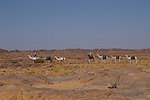
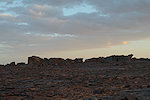
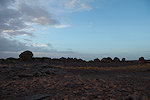
Takédédoumatine is a cluster of rocks on the top of the generally flat plateau about 12 kilometres to the south-south-west of Tissoukaï, it is the only remaining area covered by the Lhote missions which I have never visited before. It is a little offset from the regular camel trail from Tissoukaï to Tin Imgharen (Tin Bedjedj of Brenans & Lhote), it is very rarely visited. I am only aware of a single visit by Annie Mouchet and Bernard Fouilleux in 2007, to my knowledge nobody else had been there other than local nomads in the intervening years. Annie and Bernard only made a brief visit, but the 27 sheets the Lhote mission prepared in 1960 suggested a rather large and important site. We planned to spend the afternoon plus the morning there to find as many of the panels as possible, satellite imagery provided a fairly good overview of the places to be searched. We started out from Tissoukaï in the morning, and continued along the generally flat plateau (with a short lunch break) till mid-afternoon.
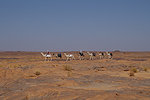
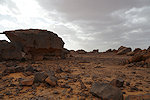
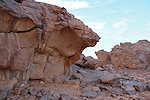
By the time we reached Takédédoumatine dark clouds moved in, it was a rather gloomy afternoon but there was no rain. The camels moved to camp south of the sites, while we made our way to the northern cluster of rocks, the only area where I had some waypoints from Bernard. We were aiming for a large conspicuous shelter along the eastern edge, which contained a large panel of mostly caballine paintings with some faint older scenes underneath, copied by the Lhote mission.
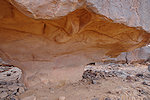
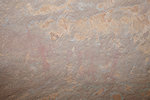
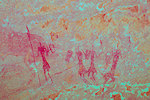
Not far to the north, in a wall niche among a cluster of larger rocks we found another of the Lhote copies, a herd of cattle with archers.
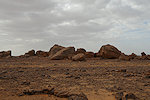
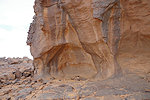
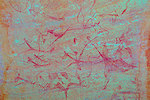
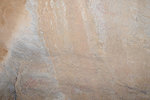
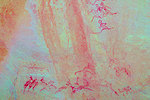
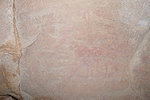
Near the northern end of the rocks there was a wall with some remnants of paintings (also noted as such by Bernard), I only realised with DStretch back home that this was the panel with the very interesting Iheren style elephant and human figure copied by Lhote, one of the "must see" panels at this locality.
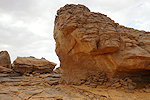
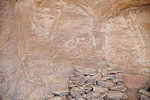
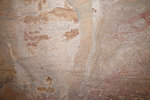
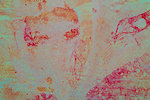
Walking anticlockwise among the rocks, in a relatively small and inconspicuous shelter we found another panel of Lhote, with numerous cattle and human figures, though in a rather poor state of preservation.
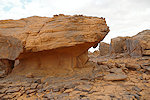
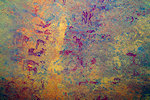
On a rock not far from here we found another large known site, a complex panel with a small hippopotamus and many other figures along the wall of a shelter under a large rock.
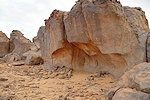
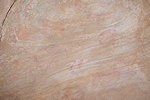
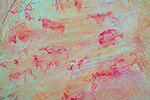
It was approaching sunset, we needed to move towards camp. Bernard's last position was at a rock towards the southern edge of the northern cluster, as we walked towards it we found two more sites, one the fine panel of gazelle, ostrich and hunters copied by Lhote, the other a minor unrecorded site with some undecypherable Iheren style scenes under more recent cattle. The final site marked by Bernard had mostly caballine scenes superimposed over very faint earlier figures, recorded by Lhote.
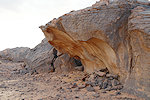
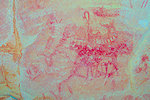
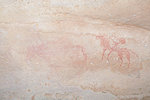
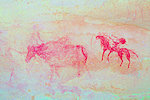
Our camp was about 500 metres beyond the southern cluster of sites among a group of rocks that provided shade from morning till early afternoon, it was almost dark by the time we arrived guided by the small fire of our crew.
Day 12. – Takédédoumatine - Tin Imgharen
We had the whole morning to search the southern cluster (where we had no waypoints) plus some outliers further to the south east near our camp. After a quick breakfast at sunrise we started out, leaving the packing of the camp for midday. At the most likely spot, along a big double shelter facing the central "Great plaza" we immediately found two of the Lhote panels.
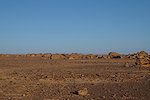
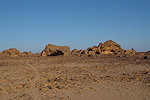
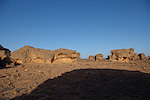
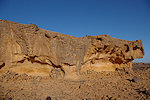
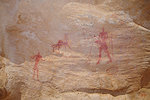
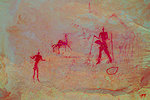
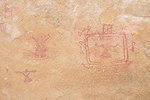
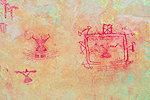
We continued searching the area around the "Great plaza", and we did find several smaller sites, but none matched any of the Lhote relevés
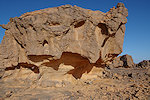

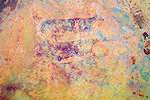
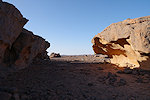
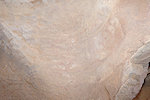
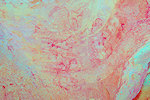
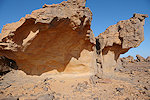
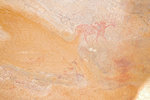
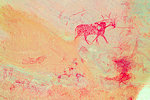
Finally one of us stumbled upon the big roundhead site familiar from the Lhote copy near the western edge of the rocks, at a rather unimpressive small shelter.
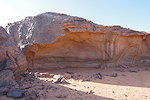
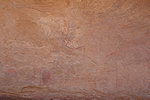
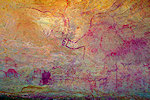
We found another of the Lhote copies near the northern end of the cluster, a large overhanging shelter under a rock with a large herd of cattle, surrounded by a strange black zigzag line.
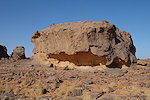
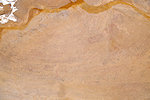
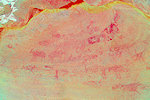
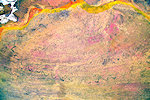
Searching every rock, we found two more minor sites nearby, but we still had a number of the Lhote panels missing with most possibilities exhausted, including perhaps the most important one, a chariot superimposed over a roundhead barbary sheep.
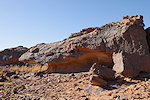
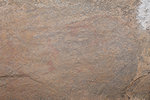
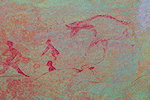
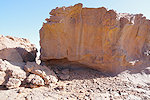
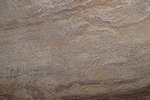
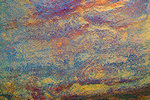
While we have covered most of the northern area, with Fenny we returned to look at a small site she found the day earlier, which turned out to be one of the missing Lhote panels. We spent some time searching remaining unlikely rocks, but found nothing else.
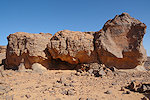
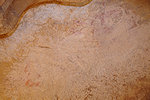
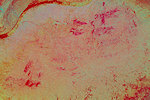
There were some scattered rocks about 500m to the south east from the southern cluster, that was the last area we haven't searched. With Fenny we made a fairly thorough check of all likely surfaces, but only found one minor unrecorded site.
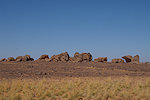
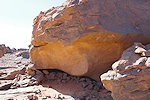
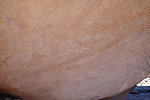
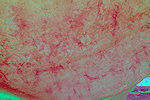
It was still only mid-morning, and our departure was only due after lunch, we were not ready to give up that easily. With Peter we returned to the northern cluster, where there might have been some gaps in our search. The hunch was right, not far from the large damaged cattle herd I found a small shelter with one of the missing scenes on the ceiling. Peter also recalled that he thought he saw something other than I did in the shelter found by Fenny, we went to check and indeed that too turned out to be another of the Lhote panels.
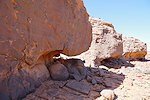
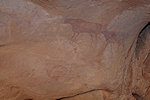
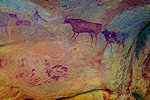
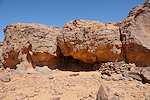
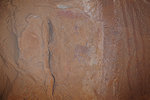
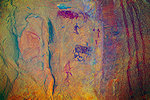
With practically every rock surface checked in the northern cluster, we returned to the southern one to do the same. Time was pressing as we promised to be beck in camp by noon for lunch and to pack. As we were about to give up and leave, I checked one last area enclosed by rocks facing the way to camp which I did not enter before, and the chariot and mouflon was right there in the corner, we must have passed right by dozens of times.
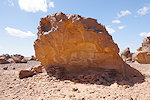
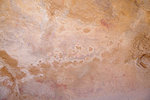

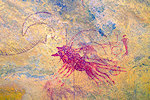
Over the course of a day we have managed to locate 19 out of the 27 copies prepared by the Lhote mission in 1960. Despite a thorough search of all surfaces we still could not find eight, but our time was up, we needed to move on. After lunch we packed camp for our luggage to be ready for loading onto the camels, then with Abu Bakr we set out towards Tin Imgharen in a southerly direction. We made a small detour to see a small site with paintings reported by Bernard Fouilleux (as Tin Sémara) two kilometres to the south, not far from our previous campsite at In Hahatine (where we had the rainstorm in 2023). The site turned out to be small but with some nice late pastoral and camel period scenes.
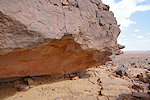
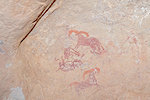
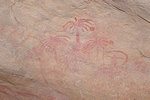
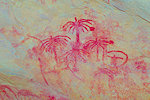
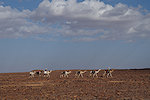
At In Hahatine we re-joined the main camel track, and continued along it on the plateau top till Tin Imgharen. Our camels caught up with us half-way, and they went ahead to fetch water at the guelta near the strange engravings which Lhote took to be Chariots, but to me they look something very different...
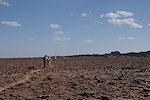
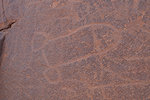
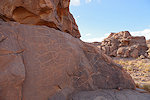
We had another one and a half kilometre to go till the big sandy plain of Tin Imgharen (Tin Bedjedj of Lhote), where already Brenans found a site with five depicted chariots. We made camp on the plain (this was the only place where we saw any others, there was a local group also camping at the far end), and made a quick visit to the chariot site.
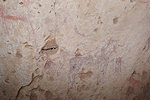
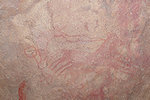
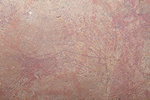
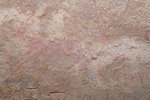
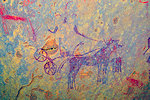
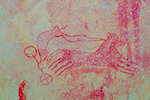
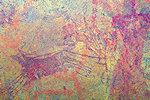
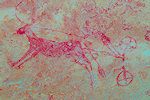
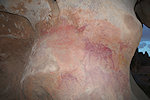
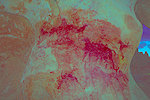
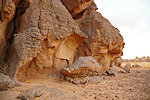
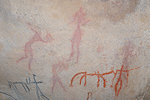
Near the southern edge of the plain, not far from our camp, Bernard Fouilleux marked two sites without any comment on their nature. Last time we did not wish to make any detours, but now we still had some time till darkness, I made a quick visit and found two camel period sites, the first quite impressive, the second less so.
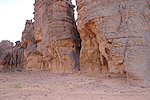
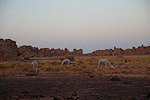
By the time I finished it was close to dark, I made my way back to camp among our camels scattered about on the plain, munching on the abundant vegetation in the shallow watercourses.
Day 13. – Tin Imgharen - Ouan Agouba
We had a fairly long walk ahead of us, the distance from camp to Ouan Agouba was about 12 kilometres, so we planned for an early start. We were all packed up and ready to go, when Abu Bakr came up to me saying that he just found some paintings - in the little shelter that was used as the camp kitchen.
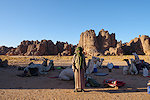
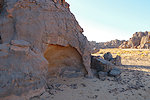
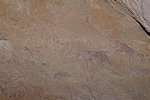
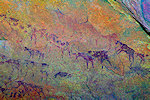
After this interlude we were ready for the real start, we continued towards the east passing by the row of sites along the sides of the eastern extension of the Tin Imgharen basin. This time I managed to take good photos of the almost invisible chariot at MG 10, which based on Lhote's publication was long thought to be at the same site as the other five.
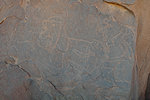
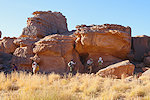
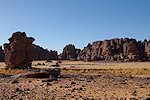
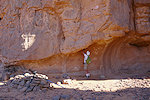
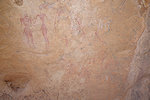
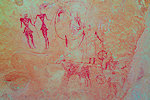
We continued to the sandy valley of Tin Tekelt, where we made a lengthy stop at the spectacular roundhead site first reported by Brenans (and re-located by Bernard Fouilleux).
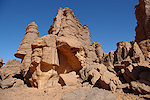
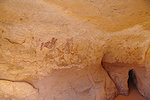
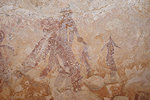
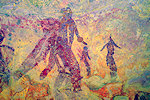
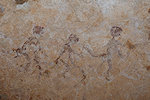
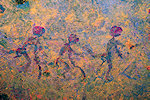
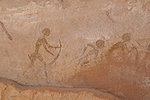
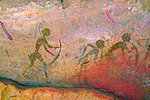
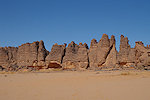
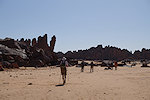
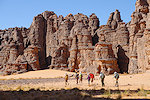
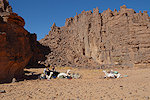
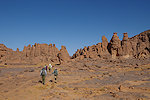
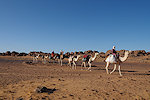
Our camels passed us as we were photographing the site, continuing to the agreed midday resting place. We soon followed, catching up with them in about an hour in the shade of a large rock tower. Poor Kent had been limping with a bad blister for several days, finally this time we could convince him that as there will be no sites along the rest of the way, he might as well mount a camel for the afternoon, a spare having been with us all along for just such an occasion. After lunch we continued for most of the afternoon, reaching camp in the southern valley of Ouan Agouba (also called Tin Tartaït) about an hour before sunset.
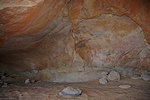
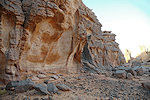
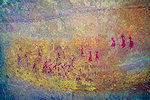
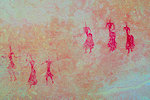
We still had time to make a quick visit to the main site of the southern area, site OA 23 with the roundhead paintings and numerous superpositions including a chariot over them.
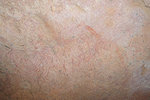
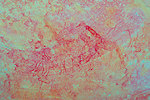
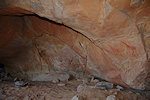
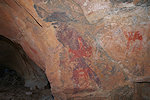
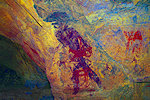
With still some daylight left, I used this time to find one nearby site marked on the Lhote map which we missed during our October 2022 visit.
Day 14. – Ouan Agouba
The only time we visited Ouan Aguba was in October 2022, when we made a day trip out of In Itinen, combining it with Ouan Derbauen. We only had a hurried afternoon, while Lhote prepared a map marking the sites we did not have the time to search for all. We did find many of the most important sites, but far from every one. This time we planned to spend three nights here, with one full day allotted to the remaining sites of Ouan Agouba. We started the day along the edge of the northern area, progressing along the row of already known sites.
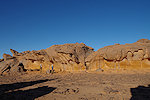
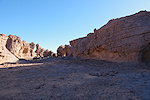
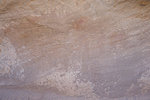
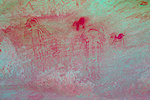
This time we all made the rather difficult scramble to reach the spectacular roundhead site of Ouan Agouba (OA 1- 2), hidden in an elevated "street" up among the rocks. The last time only I made a very brief visit, now we spent a good hour photographing the sometimes very faint scenes along both sides, finding many (especially on the western side) which I missed previously.
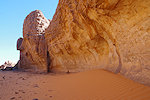
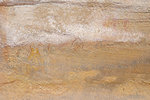
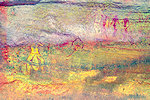
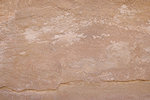
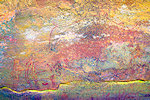
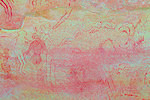
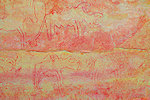
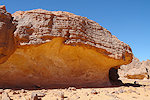
On our October 2024 trip, while the rest of us were visiting Ouan Derbauen, Bruno made a quick visit to Ouan Agouba to see the sites we have found two years earlier, and while making his rounds he found the splendid white antelopes and rhino site that was marked on Lhote's map, but we did not have time to visit. This time we made up for this omission, and on the way also passed a site recorded by Bernard Fouilleux that appears to show a big leg (in reality the back of an almost disappeared antelope) which strangely was not copied by the Lhote mission. We also found a few undocumented scenes in the vicinity, including a fine pair of elephants.
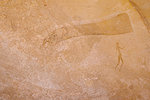
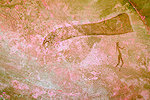
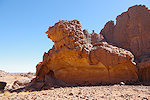
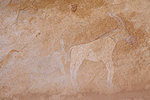
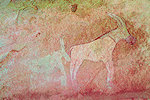
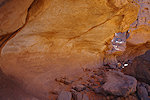
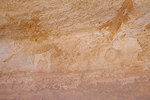
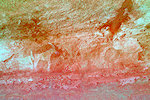
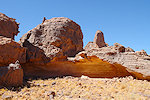
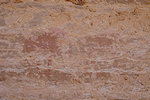
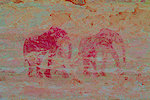
We completed our round of the northern cluster at the central group of sites, with better lighting at the strange big hoofed animal (with DStretch it appears to be a cow, with udder and red teats) , finishing at the delightful little scene of a woman hunting a hare.
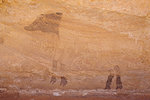
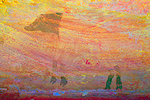
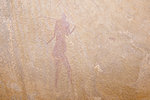
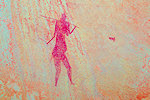
While we were busy taking photos at all these sites, Abu Bakr set about searching, and in a small shelter just behind one of the known sites he found one of the missing scenes depicted on a Lhote relevé. A dozen metres away he found more paintings in another shelter which apparently were not copied, including a lovely running feline (or canid ?) in the roundhead style.
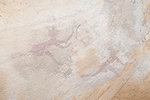
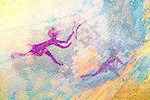
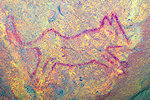
By this time it was past noon, we returned to our camp for lunch and a short rest, before heading out again, this time to the southern part of Ouan Agouba, mostly within sight of camp. We started at the most important site (OA 29), which we did not see in 2022 (we had to omit this cluster due to lack of time), but I had Bernard's coordinates so we did not need to search.
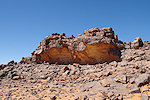
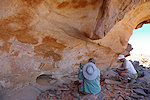
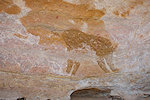
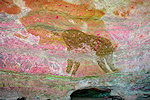
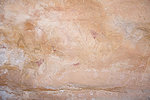
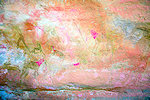
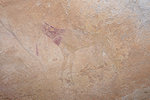
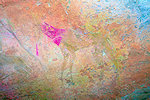
On the Lhote map there were four sites marked among the rocks to the west of OA 29, presumably corresponding to at least as many relevés or possibly more. We went to the first point marked, and immediately found the first site with the strange pig-like animal right where indicated. The second with the faint gazelle was nearby, but a little offset from where we expected it to be.
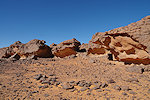
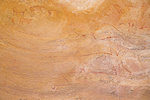
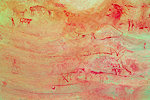
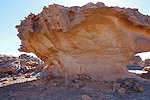
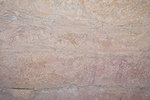
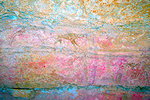
The other two turned out to be more difficult, finally Fenny found some traces of paint on a wall quite far west of where it was marked, and after a lengthy search we did find the fourth one, a fine but very faint group of humans, again quite a bit offset from the marked position.
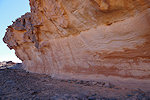
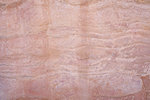
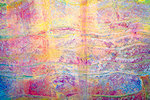
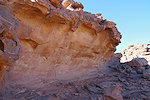
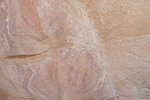
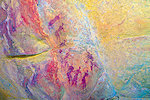
Mike, with his knack for tight places, checked out a very low shelter, and much to our surprise he found some human figures on the ceiling. There was also a panel of paintings in a prominent shelter nearby, apparently the Lhote team decided they were not worthy of copying as they would have been impossible to miss.
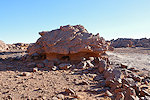
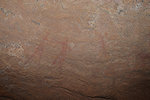
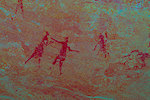
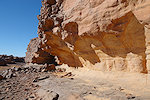
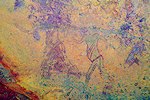
We were confident that we have searched every possible rock, so while there were still several of the Lhote relevés missing, we decided to move on to see the remaining known (mostly camel period) sites before heading back to camp for the evening.
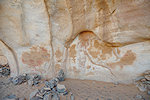
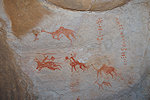
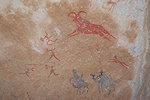
Day 15. – Ouan Agouba - Ouan Bender - Ouan Agouba
We have already made two visits to Ouan Bender in 2023 and 2024, but there were two key remaining sites which we stubbornly failed to find. A major roundhead site reported by Bernard Fouilleux (partially published in 2010 by Fouilleux et al. in Sahara 21), and Lhote's "Abri de Babylone" (MNHN 60-184) with the very interesting and markedly different group of human figures. For the first I had Bernard's waypoint, but we could not find the site at the given location. For the second, the only clue was Lhote's remark "abri suspendu à 15m", implying that the shelter is not in one of the "streets" but somewhere on the top of a rock outcrop. For both I have identified a number of possible locations based on satellite imagery, the plan was to make a day-trip to Ouan Bender to search for them, while also having an opportunity to visit some of the key known sites. We started out in the morning, and as we were searching for a way down the broad valley to the north leading towards Ouan Bender, along the cliff facing the valley I found a large shelter, and in it there were a number of faint but fine roundhead style scenes. To my knowledge no one had reported this shelter before, it was the finest new find of our trip.
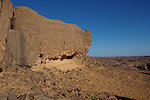
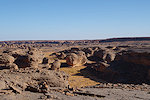
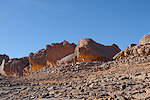
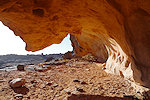
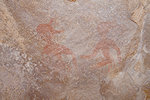
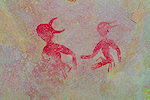
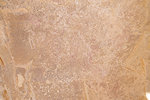
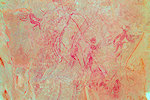
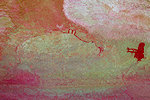
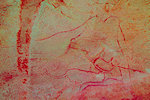
We reached Ouan Bender about two hours after starting from camp. Once arriving at the central area we stopped to photograph a number of known sites, while Abu Bakr wandered about, and within 10 minutes came back announcing that he found a big site which we did not see the year before - it turned out to be Bernard's site we were looking for, a good 80 metres from the indicated point in a completely different "street". Naturally a lengthy photo session followed, with a number of unique roundhead depictions at this shelter.
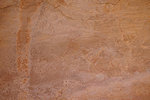
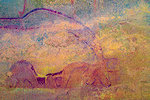
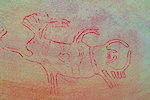
We spent a long time dispersing and checking out the various possible places for the "Abri de Babylone", but we found absolutely nothing. After a while with all locations exhausted we gave up, and leaving our packs at the first site we cherry-picked the finest sites to visit for the rest of the morning.
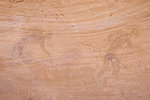
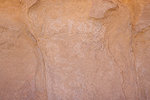
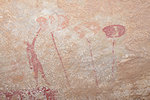
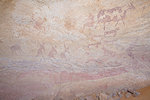
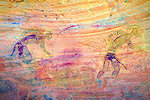
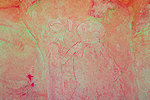
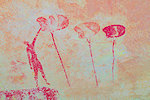
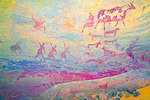
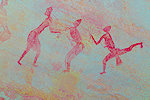
At the cluster of fine pastoralist sites Mike again searched about while the rest of us were busy taking photos, and found a small but nice new scene hidden inside a small shelter with some fine cattle and human figures. On the opposing wall I found another scene of archers which I did not see before.
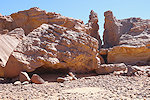
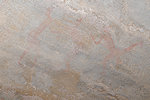
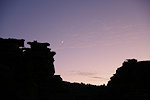
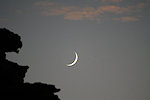
We returned to our packs to have lunch and some rest in the shade after the rather hot morning. In the afternoon we half-heartedly did some more searching for the missing Lhote site, but soon decided that it is pointless, it may be anywhere within the at least three square kilometre area, without any clues even with a systematic search it would take weeks to find it. Mid-afternoon we headed back to camp, reaching it a little after sunset, catching a glimpse of the new moon before it too disappeared.
Day 16. – Ouan Agouba - Tamrit
Tamrit was roughly 9 kilometres from our camp, a distance comfortably doable in a morning. We packed our gear and departed as the collected camels arrived to camp for loading. Kent again rode, helping his foot to heal before having to make the descent on the Akba Tafilalet. About an hour after we left, our camels caught up with us and passed, making a direct line to the camp at Tamrit.
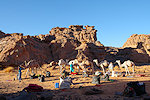
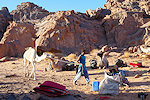
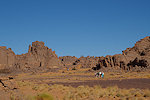
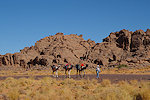
The rest of us made good progress along the easy trail, we had time to make a detour to the amazing shelter of Tan Zumeïtak, one of the few sites on the plateau that may truly be enjoyed without DStretch, and which was new to most of our party. We could spend a good hour at the site, till about midday when we covered the remaining distance to the Tamit camp, where our donkeys with their drivers were already waiting.
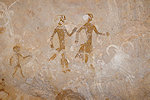
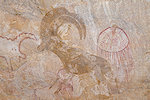
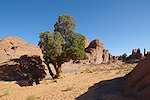
After the midday rest our camels departed to make it down to Djanet along the long route via the Akba Isselihouhene (3 days), we said good bye to our crew, only Abu Bakr remained to accompany us down with the donkeys. Once the camels departed, we made the walk down to the Tamrit valley to see the cypresses and the principal sites over the course of the afternoon.
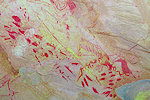
Day 17. – Tamrit - Timenzouzine - Tafilalet
This was the reserve day, in case we are delayed anywhere along the way, however we were perfectly on schedule all along so we could make the visit to Timenzouzine before heading to the top of the Akba Tafilalet for the night, to make the descent the following morning. Timenzouzine is a puzzling place: the 1957 Lhote mission prepared 58 copies attributed to this locality. Of these over repeated visits in 2022 and 2024 we have only managed to locate 24 (two of them mis-labeled, one was found at Tan Zumeïtak, the other at Jabbaren West). Of the remaining 34, 10 were attributed to a single shelter, "Le torpilleur", the rest might be anywhere. With our reserve day still free, we could afford a full-day search there in the hope of finding some of the missing panels. We started at the "Grotte des enfants" (site TM 9) nearest to the Tamrit camp, which we already visited in 2024 (it was re-located by Annie and Bernard in 2009), but we could not find the missing scene that was allotted to this site.
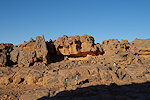
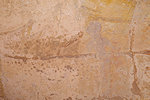
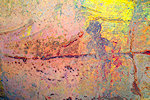
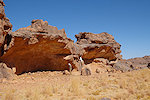
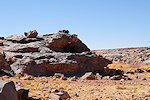
We expected to find at least something in the numerous valleys and rocky areas between TM 9 and the main corridor of Timenzouzine, but despite a very thorough search of all possible shelters and surfaces, we found absolutely nothing. We reached the main cluster of sites, there scrutinizing the high shelter behind the main valley (TM 5) we finally did find one of the missing panels on a very weathered wall, a row of small roundhead figures.
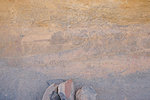
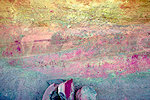
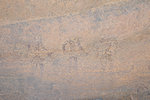
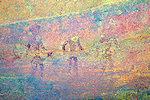
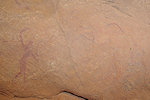
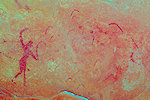
Our repeated search of the known sites in the main valley yielded nothing new. It was Abu Bakr who made the only find, in a small shelter at the beginning of the valley which we never bothered to check he found the small single figure with a curved stick and many curved lines in front (based on analogies possibly remnants of heads of a flock of sheep).
It was only mid-morning, but we were out of ideas on where to search, having already covered all possible spots in the vicinity over the course of the three separate visits. We decided to continue to the Tafilalet camp for lunch, and spend time in that area where we also had some unfinished business.
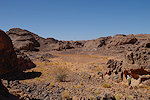
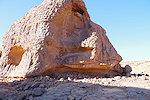
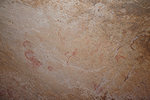
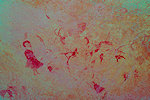
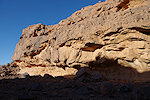
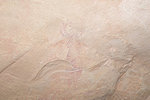
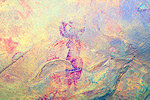
When we made the rounds of the Tafilalet sites in the afternoon, we did find two sites which we missed in 2024.
Day 18. – Akba Tafilalet - Djanet
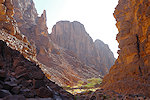
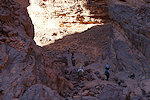
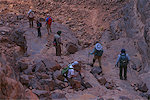
This day we only had one objective, to make it down the pass. Fortunately Kent's foot seemed fine, we set out in the morning after packing camp for the last time, and started making our way down the pass. It took about four hours to make the descent till the point where the cars were waiting to take us to Djanet.
The rest of the afternoon was spent in the Essendilene house, taking showers, packing bags and preparing for the flight home, or for the second part of the trip. There was also the option to visit the "Crying cows" for sunset to those who have not seen it before.
Day 19. – Djanet - Ouan Segofar
Only Cornelius and myself stayed for the second part of the trip, all others departed with the early morning flight to Algiers, then to onward connections home. Koen, Ugo & Magdi arrived with the same flight, for once Air Algerie was early, by 1:30am we were back in the house for a short but good sleep for the remainder of the night.
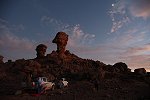
This second part of the trip was to be very different from the trips we have done before. The prime objective was not to see rock art, but to spot wildlife and observe nature, with three naturalists on the trek. The plan prepared together with Cornelius was to start at Ouan Segofar with our old guide Dagarat and camels from Tin Akn, and make a traverse generally southwards, descending on a pass about 15 kilometres to the west of the Essendilene canyon. This route traversed likely good wildlife habitats, and being off the beaten track any animals living in the area would have been less disturbed. Dagarat already arrived the evening before, and when the new arrivals woke up we started to prepare for departure with two cars. We managed to leave by 10am, stopping at the Djanet market to top up some supplies, then driving along the N3 route towards the north. In the end, with a detour to check the meeting point of our return and another to Dagarat's house for his gear, it took the whole day to reach our camp at Ouan Segofar, we arrived just after sunset.
Day 20. – Ouan Segofar
Our plan was to spend three nights at Ouan Segofar, to provide some time for any wildlife (primarily gazelles) in the area to relax after the disturbance caused by the cars. The daily routine was to be the same all along the trip, with Cornelius and Ugo, sometimes accompanied by Koen, going out before dawn to some suitable spots (preferably gueltas), and also do the same mid-afternoon till dusk, with any traverse to be done in-between if possible. With the late arrival the day before the cars stayed with us overnight, after the naturalists were back from the morning sortie we made the climb to the big shelter of Ouan Segofar (Ochi had not seen it before either).
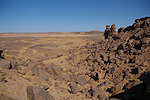
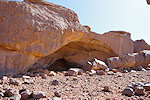
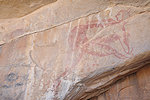
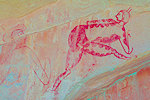
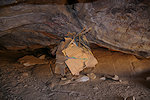
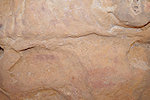
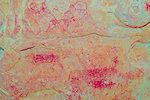
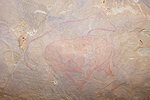
On satellite imagery I have identified a number of shelters with stone enclosures, both to the north and the south east of Ouan Segofar proper. The northern area was about 3 kilometres away, while Koen elected to return to camp the rest of us decided to take advantage of still having the cars and drive to the low row of hills before parting with them. We checked all of the identified stone structures, some were attached to suitable shelters, but we found nothing. Cornelius and Ugo split to look for animal tracks, while with Magdi we started heading back to camp. At the rear of a hill between us and camp we spotted a large shelter, and checking it out we did find a few nice paintings of cattle and human figures, with a big bundle of nomads' possessions still hanging from the ceiling. It turned out to be the only new rock art find we managed to make in the area over the two days. We got back to camp and spent a lazy afternoon, a welcome chance after the constant walking over the past nearly three weeks.
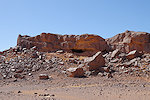
Day 21. – Ouan Segofar
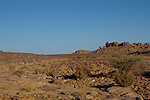
Next morning while Cornelius and Ugo were still out, we set out with Koen and Magdi to chck out a valley about five kilometres to the south east with several semicircular stone structures before shelters and a large walled-off plaza in an elevated position visible on satellite imagery. It was a pleasant walk, but all the sites turned out to be empty despite ample evidence for human occupation.
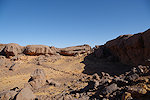
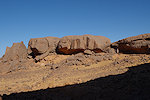
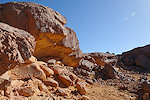
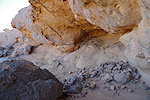
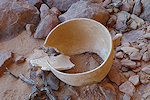
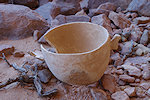
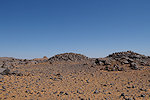
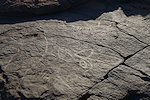
We were back at camp by midday, Cornelius and Ugo had a long walk in the basin and up on the plateau but aside some older gazelle tracks, did not see anything. After lunch and a good rest in the late afternoon we went to visit the engravings of Ti Ouaghneuen near the guelta of the same name about a kilometre and a half from our camp. In the mean time our camels arrived with their crew, we were ready to depart the next morning.
Day 22. – Ouan Segofar - Ibaren Adou
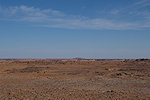
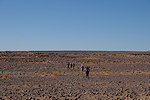
Our route was agreed with Dagarat to be generally to the south, descending on the pass and meeting the cars at midday on day 10. However, the actual daily route was pretty much determined by the camel drivers from Tin Akn, who knew the passable camel trails and also which gueltas had water, something needed for both the camels and also for wildlife spotting. Dagarat knew that our main objective was to see wildlife, we started out in the morning towards a place called Ibaren Adou, the agreed meeting place with the camels at midday. We marched towards the south west on the flat plateau, and after about two hours we came upon a broad shallow wadi with abundant vegetation. Approaching it carefully, we did find a small herd of three Dorcas gazelle grazing in the middle of the depression. They spotted us but did not bolt, for a while they looked at us until slowly they turned and retreated in a slow trot. While they were quite far it was still a reasonably good and quite unexpected photo opportunity.
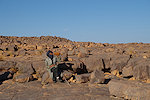
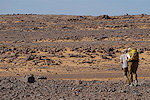
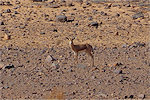
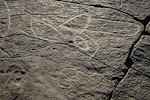
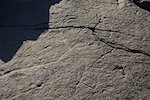
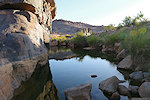
Ibaren Adou turned out to be an outcrop of rocks with some good shade and a suitable campsite along the eastern bank of the upper Oued Torset, and a big guelta in a southern tributary about a kilometre and a half from camp. The camels caught up with us soon after we arrived, we had lunch and some rest before the naturalist set out for an afternoon watch at the guelta, while Ibrahim, the chief of the camel drivers, led me & Magdi to a series of engravings he knew, up along an eastern tributary about a kilometre away. The engravings were on two separate outcrops of smooth rock, and some figures were of a very high quality, comparable to those at the not too distant Tin Terirt.
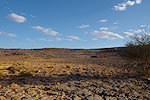
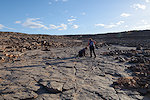
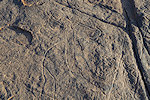
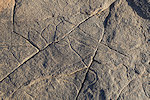
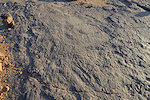
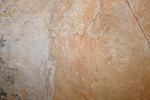
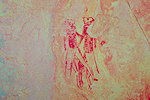
Our naturalist companions arrived well after darkness, apparently they failed to find the guelta (turned out they did not go far enough up the valley) so they set out for a watch at a suitable spot. They saw no wildlife, but Koen (who came back early) found a very interesting painting of an elephant, which we all agreed to visit the next morning.
Day 23. – Ibaren Adou - Irrekam n'Oudi - Iseren
Cornelius and Ugo left before dawn to this time really make it to the guelta, we agreed to meet at Koen's elephant in the morning. Rest of us slept till daybreak and packed camp before heading to the site, which was very nice indeed. There were also two human figures in the shelter, with stylistic affinities not exactly clear.
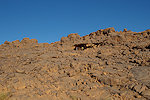
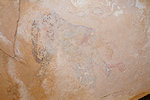
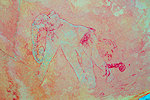
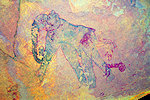
We were to continue upstream along the Oued Torset towards Irrekan n'Oudi, a place we have already visited with Dagarat in 2023. I was expecting to go towards the south, but Ibrahim explained that there was no direct way through the hills, we first need to make a detour towards the west.
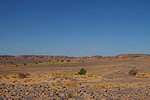
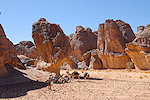
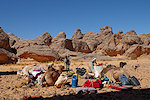
We reached the rock outcrops of Irrekam n'Oudi by midday, stopping at the same place for the midday rest. This gave me the opportunity to take better photos of the very damaged shelter nearby, where last time I noted an interesting giraffe butchering scene. Unfortunately the scene is so faint that once again I managed to cut the head of the giraffe from the close-up photos.
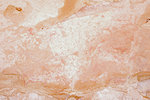
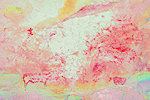
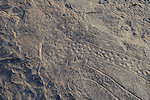
After the midday break we continued towards the south west across a large plain called Iseren where Dagarat was hoping to see gazelle again. Unfortunately there were none, but in the middle of the plain we found a rock with a nice engraved rhinoceros.
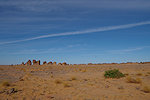
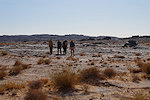
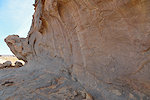
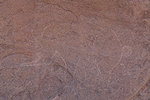
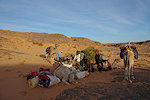
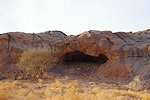
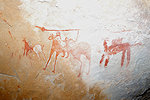
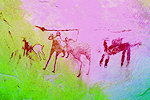
The camels caught up with us at the far end of the plain, as sunset was approaching. We made camp at a small sandy patch, close to a small shelter that had some otherwise unexciting camel period paintings, but next to the two women seated in some small enclosures (the large oval was added later) there is an unmistakable harp, one of only two such depictions I'm aware of in the entire Tassili (there are many more in the Ennedi).
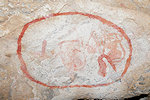
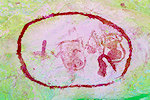
Day 24. – Iseren - In Djoua
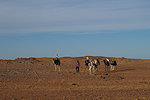
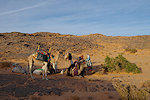
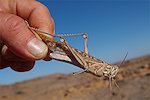
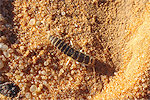
Before dawn the naturalist party set out to the edge of the broad valley along our route about a kilometre from camp which they have already scouted the previous evening, in hope of catching some grazing animals out on the plain at sunrise. We were to follow once the camp was packed and ready for loading. We were planning a long morning march till the shelter of In Djoua and a little beyond, to camp in the vicinity of another big guelta that may attract barbary sheep and possibly gazelle. We started out about an hour after sunrise, and soon caught up with the others, who again did not see anything. This is not to say we saw no animals, only the large mammals were lacking, there was plenty of life along the way under our feet. In the morning I caught a big Desert Locust (Schistocerca gregaria) that was still a bit stiff after the cold night, and a little later I found a rarity, a Zygentoma (silverfish) species which I have never encountered before anywhere in the Tassili (and only once at Jebel Uweinat). We also passed a guelta with the typical water beetles, but saw no fresh tracks of any larger mammals around it.
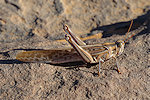
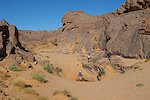
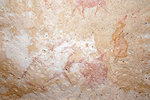
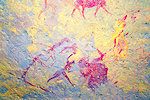
We reached the shelter of In Djoua, we had a brief look but the paintings here are not very impressive save for a few better Iheren style figures. We continued and soon the camels caught up, and we also encountered a very friendly agama that posed for the cameras.
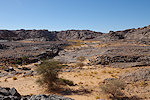
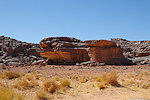
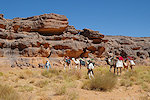
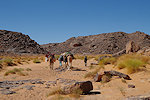
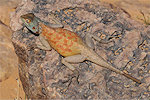
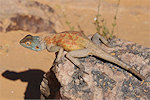
We made camp along the bank of the oued after the In Djoua shelter where a low scarp offered some afternoon shade. There was a big guelta in a nearby tributary, and also several large shelters to be checked out along the cliffs of the wadi. After the midday rest we dispersed, but none of us seemed to have any luck, there were no animals and all the shelters were empty.
Day 25. – In Djoua - Oued Zarzawa
The previous day I had a discussion with Dagarat regarding our route. It was clear that we were going generally west rather than south, at this point we have re-joined our 2023 track. It emerged that the camel drivers intended to take the same route till reaching the Dider plain, then take a transverse valley south towards our agreed rendez-vous point. As that route was well traveled, it was completely contrary to our intentions of keeping to secluded, undisturbed areas. On further interrogation Dagarat confessed that he did not personally know the pass we originally intended to take, and the camel drivers said that it was not suitable for camels. As we were in no position to contest this (and at this stage it would have been a rather grueling forced march to make it), in the evening we re-planned our remaining days and decided that our best option was to make a two night's camp upstream of the Guelta Moulay in the Oued Zarzawa, a large reliable water source which is quite far from any traveled trails. It would also be close to the rock art sites of Ibessukan, where I still had some unfinished business. We covered the eight kilometres in a few hours, we reached our campsite before noon.
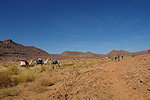
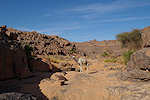
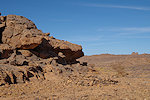
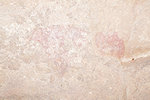
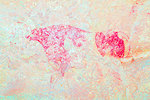
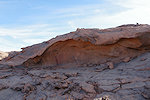
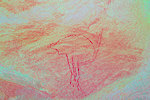
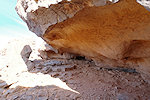
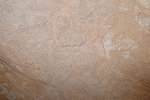
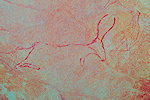
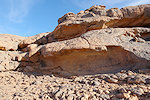
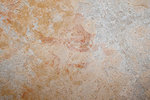
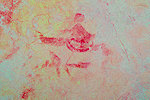
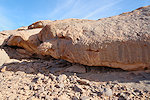
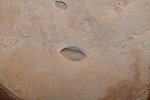
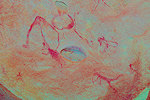
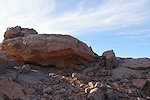
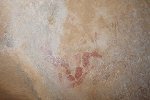
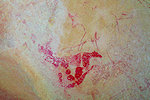
In the afternoon the naturalists went to see the gueltas, Magdi decided to call a lazy afternoon, so I went alone up in the small tributary that led towards Ibessukan. My target was a series of scarps to the north of the sites we found in 2023, where satellite imagery showed some likely shelters facing the main watercourse. My hunch was correct, I found a total of six shelters with paintings (though three with only one or two figures), but contrary to expectations none of them was the panel Aumassip published in Libyca XXI which we failed to find last time.

Day 26. – Ibessukan
Cornelius and Ugo disappeared towards the gueltas before dawn, and they said they will be gone for the day, with Magdi & Koen we headed to Ibessukan for the day, taking up the search where I left it off the previous afternoon, and found one more shelter with paintings before reaching the cluster of known sites.
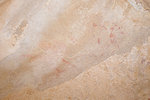
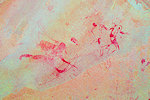
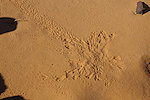
In the sand in front of one of the shelters I found a very curious set of tracks, Koen immediately recognised them: an owl swooped down on a gerbil emerging from a well used hole (and collapsing the hole in the process), a moderately bad day for the gerbil, but certainly a good one for the owl.
We continued to our 2023 sites, a repeated scrutiny revealed a few more details, but there was still no sign of the Aumassip panel.
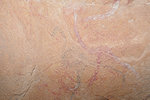

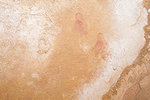
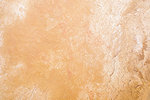
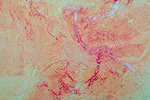
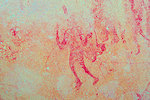
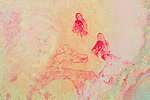
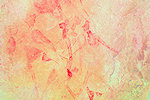
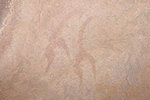
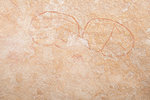
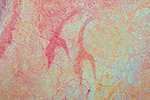
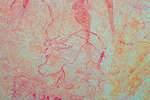
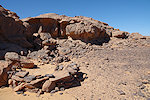
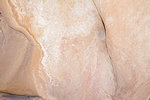
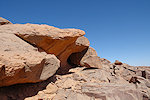
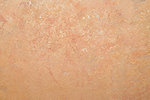
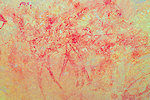
We split to search the areas not covered in 2023 and I was the lucky one, there was a fine big site along the far side of the ridge bordering the known cluster - but again not Aumassip's site. At first I only noticed the dark pair of giraffe, but looking at the photos taken on the camera screen where smetimes things are more visible than in real life, I spotted under the feet of the giraffe a bizarre rabbit-eared small hippopotamus, the likes of which I have never seen elsewhere. There were other Iheren style fugures in the shelter, but the hippo surpassed everything.
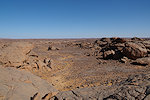
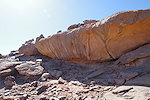
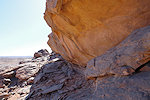

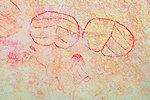
Continuing our search well into the afternoon we found a few more minor sites, but the panel reported by Aumassip remained elusive.
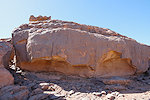
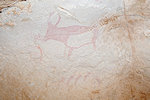
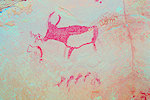

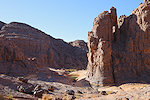
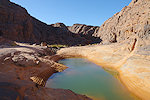
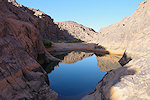
We still had plenty of daylight by the time we returned to camp. The other two were nowhere to be seen, Magdi decided to call it a day, while with Koen we went to visit the chain of gueltas till the one blocking any further way (unless climbing on the rocks above). We saw nothing special, but had a lovely peaceful walk in the complete silence.
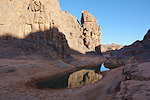
Day 27. – Oued Zarzawa - Efehi
From our camp in the Oued Zarzawa we could have reached the Dider plain in a long day, but we still had a day and a half left till the rendez-vous with the cars (have called Salah and changed the pick-up to Dider), so we could make a leisurely day. We were not following our previous route via Immeseridjen, but continued along a wadi running directly towards the west. The region between Ibessukan and Dider is the Efehi plateau, we planned to camp at a series of large gueltas near our half-way point.
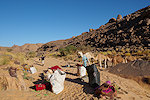
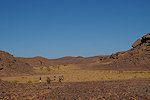
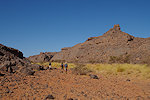
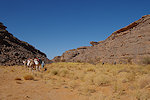
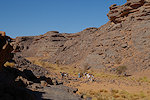
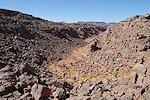
Our camp was at a place where the east-west oriented wadi of our route was crossed by a south-north one (probably both following perpendicular faults in the rock), with a series of gueltas in the latter both upstream and downstream of our camp. The naturalist party chose the southern ones for the afternoon, so I explored the northern area following the wadi downstream in the hope of finding some rock art, but there was none. We all converged on camp by moonrise, and had a very peaceful last night in the desert.
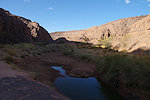
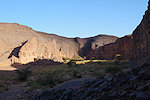
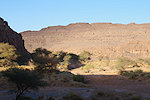
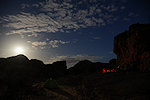
Day 28. – Efehi - Dider - Djanet
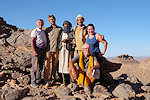
We had six kilometres to go till the Dider plain. Along the way we took our group photo, then continued down a series of low escarpments towards the Dider plain, reaching it roughly opposite the engravings of Tin Terirt. We reached the rendez-vous point early, we had to wait a good two hours for the cars to arrive.
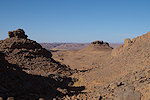
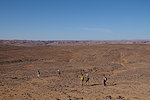
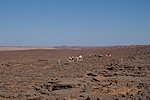
We said good bye to our camel drivers who set off immediately towards Tin Akn as the cars arrived, while we loaded our bags and set off towards Djanet. Once we reached Tim Ras Oichi split to the right with Ugo and Cornelius to visit the "Crying cows" while the rest of us drove straight to the Essendilene house to tidy up and pack for the flight to Algiers and then home early the next morning.
We plan to return to the Adjefou - Ozaneare - Jabbaren areas of the Tassili n'Ajjer again in October 2026, to spend more time looking for remaining "lost" sites. Please check the News page periodically or "like" the FJ Expeditions FaceBook page to receive notices of news and updates.